









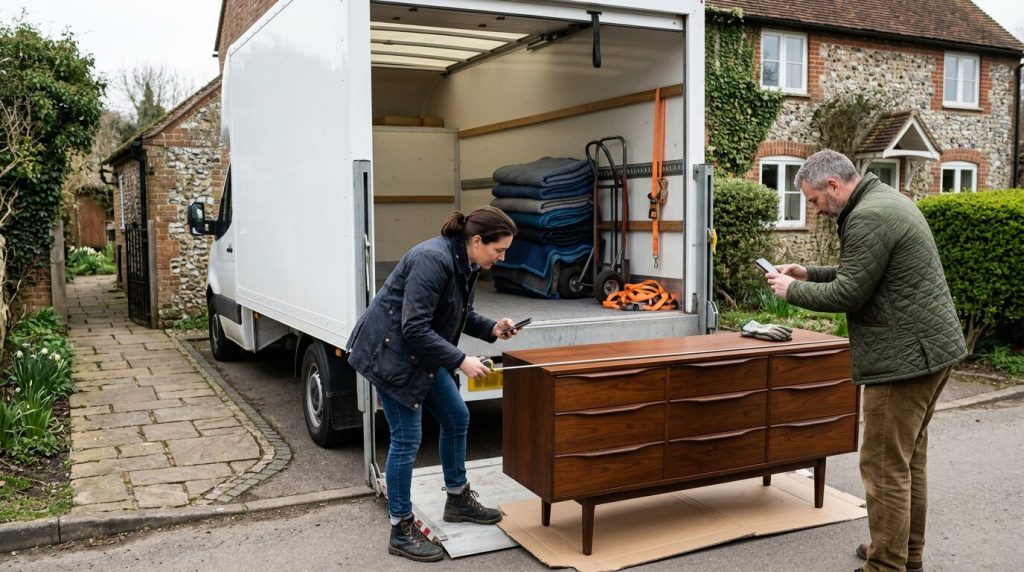
Most interior projects have a moment when the plan depends on one piece: the mid-century sideboard spotted at an auction, the reclaimed dresser from a second-hand shop, the garden bench or the piano a neighbour is giving away. The seller is happy for you to collect, and delivery would cost more than you’d like. So you hire a van for the afternoon. What could go wrong?
Usually one of three things. The item, in its packaging, is bigger than you were told. The route from the shop floor to the van, or from the van to your living room, has a step, a tight turn or a narrow door nobody measured. Or the one friend who promised to help can’t make it. All three are avoidable with a bit of preparation, and this checklist is built around them.
Ask for the packed measurements, not the product size
Product pages list the size of the finished item. What you’re collecting may be quite different: flat-packed in several long boxes, wrapped on a pallet, or assembled with legs that don’t come off. Ask the seller three questions:
- What are the packed dimensions of each box or piece, including the longest one?
- Roughly how much does the heaviest piece weigh?
- Does it have to stay upright, or can it lie flat?
Then compare those numbers with the van’s rear door opening, not just its load length. A van that’s long enough inside can still have a door that’s too low for a tall wardrobe to go in standing up.
Inspect access at both ends
Think about the whole route the item takes, from where it’s stored to where it’s going.
- At the shop or seller: Is there a loading area, or will you park on the street? Will staff help carry it out, or is it all on you? Is there a collection window?
- At home: Can the van park close to the door? Are there steps, a narrow hallway, a tight landing or a staircase that turns? Measure the narrowest point.
If the item won’t go through your front door in one piece, you need to know that before you load it, not on the doorstep.
The purchase collection sheet
Fill this in before you book a van. Keep it on your phone on the day.
| Item | Your notes |
|---|---|
| Seller name and collection address | |
| Collection window agreed | |
| Packed dimensions, longest piece (L × W × H) | |
| Heaviest piece (approx. kg) | |
| Must stay upright? | |
| Access at collection (steps, distance to van, staff help?) | |
| Access at home (parking, steps, narrowest door or stair) | |
| Helpers confirmed (names and times) | |
| Straps, blankets, sack truck packed? | |
| Van collected / due back (time) | |
| Condition photos taken at collection? |
Two enquiry options
Where you hire from depends on where the purchase is and where you live. The boxes below are two examples for different parts of southern England, one in Wiltshire and one in Hampshire. If your find is elsewhere, the same questions apply to any hirer near the collection point. They are not a comparison.
Swindon, Wiltshire
Website: van hire information for Swindon
What the page lists: panel vans from short to extra-long wheelbase, Luton and low-floor Luton vans, and a crew-cab van, with the stated load length for each, plus delivery and collection. It mentions hourly as well as daily hire.
Worth asking: the rear door height of the van you’d get, whether a Luton with tail lift is available on the day, and the deposit and insurance excess.
Alton, Hampshire
Website: van availability in Alton
What the page lists: vans from a small Caddy through Transit and Sprinter panel vans to a Luton box van with tail lift, with delivery and collection mentioned.
Worth asking: whether a short or half-day hire is possible for a single collection, what documents the driver needs, and the exact return time.
Contact details aren’t repeated here. Check them on each website and confirm terms directly.
Arrange help and load it safely
Heavy, awkward items are a two-person job at minimum. Confirm your helper in advance and agree how they’ll get there. A crew-cab van has extra seats, but in a standard van passengers ride in the cab seats only and never in the back.
Once it’s in, it needs to stay put. GOV.UK’s load-securing guidance for vans suggests loading against the bulkhead and securing large or heavy items to the vehicle. Bring your own straps and blankets rather than assuming the hirer will supply them. And if you’re tempted to skip the van and put something on a car roof rack instead, the same guidance says to use ratchet straps or proper clamping, not rope or bungee cords, and never to load items straight onto a car roof.
Record the condition when you collect
Before the item goes into the van, take a few photos of it from each side, close up on any marks or damage. Auction and second-hand pieces are often sold as seen, so a record of their condition at collection is worth having. Do the same with the van itself: a walk round with your phone, plus the fuel gauge and mileage. It takes two minutes and settles almost any later disagreement, whether with the seller about a scratch or with the hirer about a dent.
Then drive gently, park as close to home as you can, and leave enough time on the hire to get the van back without rushing. The moment the sideboard is in place, nobody will remember the planning. They’ll only remember if it went wrong.